“My brain on AI, though, can beat your brain on AI all day long because I’ve got 40 years of judgment built in. . . . So continuing to build that critical judgment, learning, wargaming, sort of adversarial thinking is going to be critical. [AI] has real implications for education, right?” says Niloofar Razi Howe, distinguished visiting professor at Vanderbilt University. “There is a real path for being a productive member of society without needing a four-year education. And that path has to become more real for a larger portion of the workforce.”
This work represents the views and opinions solely of the author. The Council on Foreign Relations is an independent, nonpartisan membership organization, think tank, and publisher, and takes no institutional positions on matters of policy.
Ukrainian drones struck several targets around Moscow on Wednesday night, setting an oil refinery on fire and forcing the Russian capital’s airports to suspend flights.
Both Ukrainian President Volodymyr Zelenskyy and Moscow Mayor Sergei Sobyanin confirmed the attacks. Photos and videos circulating on social media and news agencies showed the refinery on fire, with thick black smoke rising above the site.
“Last night, our long-range sanctions once again reached the Moscow region — for the second time this week, the Moscow oil refinery was hit,” Zelenskyy wrote on X on Thursday morning.
Sobyanin said Russian air defenses had intercepted at least 180 drones heading toward the capital. In a post on Telegram, he added that one drone struck a shopping center building.
Russian media reported a high-rise residential building and several private homes were hit during the attacks. All four of Moscow’s airports — Vnukovo, Domodedovo, Zhukovsky and Sheremetyevo — shut down arrivals and departures on Thursday morning because of the strikes.
Zelenskyy also confirmed attacks in Russia’s Rostov region and in Russian-occupied parts of Ukraine. Russian state media reported that one person was killed and two others injured in the strikes in Rostov.
The Ukrainian president characterized the operation as “fully justified” retaliation for Russia’s large-scale attacks on Kyiv and other cities that left several dead and the iconic Dormition Cathedral in Kyiv in flames last weekend. The strikes, he added, were “another important result of our warriors’ work against facilities that sustain Russia’s war machine.”
Zelenskyy also urged Moscow to negotiate. “It is time the war ended, and Russia must take the necessary steps in diplomacy,” he wrote.
Ukraine hit a Moscow oil refinery for a second time in a week and disrupted commercial flights at Moscow airports in one of its biggest drone attacks since Russia's invasion more than four years ago, Russian officials said Thursday.
The fancifully named Department of Government Efficiency is grounded in a fundamental misapprehension of how the federal government works. The recklessness and destruction is not a bug but a feature.
“We think of low taxes and deregulation as absence of government,” O’Mara said. “But actually those are government decisions that were made favorable — very deliberately so — [to] this [tech] industry.”
If you’re struggling or just want to improve, consider therapy with our sponsor BetterHelp 👉🏻 https://betterhelp.com/mentourpilot for a 10% discount on your first month of therapy with a licensed professional, specific to your needs. ----------------------------------------------------- Airpressure.. You can sometimes feel changes in it, as you are driving through a tunnel or down a hill but you wouldn’t think it is something that could bring a huge airplane down. But as it turns out, if you combine some minor deviations from procedures with a rapidly changing pressure... Really bad things can happen. Stay tuned. ----------------------------------------------------- If you want to support the work I do on the channel, join my Patreon crew and get awesome perks and help me move the channel forward! 👉🏻 https://www.patreon.com/mentourpilot
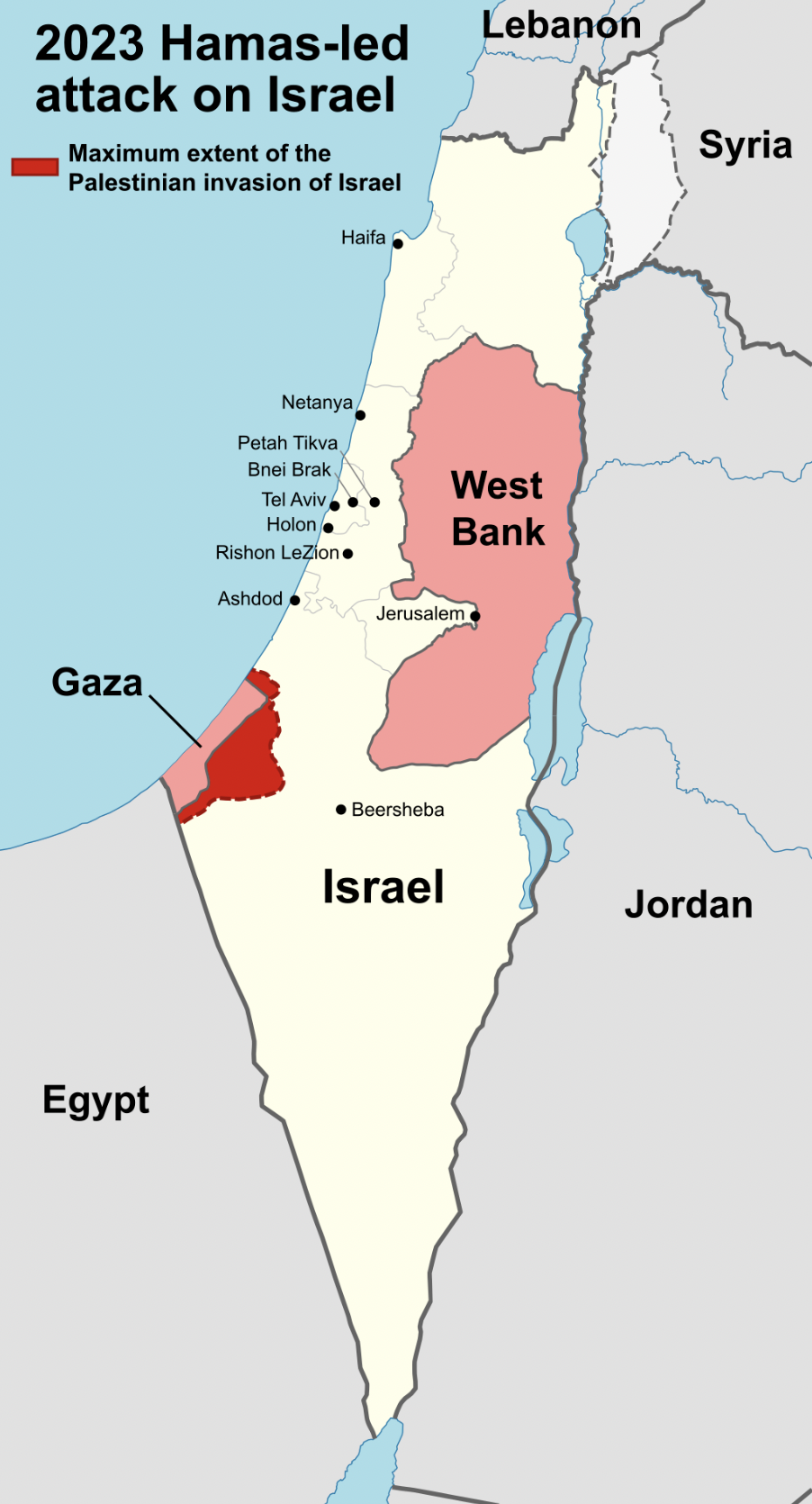
I don’t think that Erik is quite wrong in his assertion that Hamas is winning this fight, but Palestinians as a whole are definitely losing. Hamas’ attack was designed to forestall normalization between Israel and the Gulf monarchies by triggering a massive Israeli counter-response, to further establish the credit of the organization with the Palestinian people, and to mobilize international opinion against Israel. In this it has largely succeeded… but at extraordinary cost. The Gaza Strip has been governed by Palestinians since 2005, but it is no longer so governed, and it is not obvious when it will be returned in part or in whole to Palestinian control. Whoever controls Gaza in the future, its infrastructure has been effectively destroyed (this includes extensive damage to the military infrastructure that Hamas has built since 2006). In the West Bank, settler violence has become endemic and Palestinians have lost both territory and autonomy. And while I hesitate to cite the numbers that both Hamas and Israel have every incentive to cook, it’s clear at this point that the Israeli counter-offensive has killed more Palestinians than the First and Second Intifadas combined, and likely by a factor of five or more. Moreover, as Erik mentions, while Israeli society is hardly united behind Bibi it absolutely does strongly support the continuation of the war.
The international reaction has been significant in some ways but muted in others. Colombia’s decision to cut ties with Israel is consequential (Colombia has been a major Israeli partner for decades) but it’s obviously not enough. Israel has cultivated extensive trade and technological ties with the Indo-Pacific both as a growth strategy and as a means of warding off international pressure (presumed to be coming from Europe and North America), and this strategy has largely worked. The trade relationship with India is important (although perhaps not as important as Modi’s raw hatred of Muslims). China has made more pro-Palestinian noises than India, but I regret to report to you that China does not conduct its trade relations with much (or any) consideration for the human rights of Muslim minority populations. Russia is too fixated on Ukraine to be helpful (and also has a series of long-term trade and social connections with Israel), while the Europeans are also too fixated on Ukraine to worry overmuch about sanctioning Israel.
Locally the story isn’t much better for the Palestinians. Again, the Gulf monarchies have made pro-Palestinian, anti-Israel noises, but that’s about as far as it’s gone. Houthi and Iranian intervention in the war have NOT, as you might imagine, made Riyadh less interested in long-term rapprochement with Jerusalem. Jordan’s military cooperation with Israel and the United States during the Iranian missile barrage is probably the most consequential security collaboration between Israel and an Arab state since… well, possibly ever. It seems very possible to me that this war will represent a delay rather than a termination of the long-term process of solidification of Saudi-Israeli military and political ties.
All of this makes debates about what pro-Palestinian protestors mean when they chant “From the river to the sea, etc.” quite academic. Whether they mean the ethnic cleansing of Jews, or the establishment of a binational democratic state, or the establishment of a sovereign and independent Palestinian state within current borders… all of these are farther away than they were on October 6. Hamas cannot destroy Israel or seriously weaken it; Hamas cannot convince Israelis to abandon apartheid; Hamas cannot establish and defend either borders or an extensive governing authority; it cannot convince Israel to allow refugees of the Nakba to return. Palestinians are less capable of doing any of these things than at any point since 2005 and possibly since 1967. Moreover, it is extremely difficult for me to develop a scenario where the Palestinian situation with respect to any of these objectives improves appreciably over the next few months and years.
I think it’s important for folks to appreciate that when one protestor holds up a sign “Immediate Ceasefire!” and a second protestor holds up a sign that says “Free Palestine,” they are calling for much different things. We will eventually get a ceasefire of some sort in Gaza, although how long it will last and the nature of its terms are hard to predict. But when we get that ceasefire the Palestinian cause will be in far, far worse shape than it was before Hamas broke the ceasefire that had held for several years with Israel. Moreover, the road back to even the “normal” that held before this was began is deeply unclear. The most consequential effect of 10/7 and the Israeli counter-attack could, quite bluntly, be the election of Donald Trump in November 2024, and I am sorry to report to you that the re-ascension of Trump to the White House would be INCREDIBLY BAD for Palestinian national aspirations and for the daily health and security of the Palestinian people.
So yes… maybe Hamas is winning, and it’s even possible that Israel is in some sense losing. But the Palestinians are absolutely losing from this war in every way that a people can be losing; economically, socially, politically, and territorially.
 Log in